

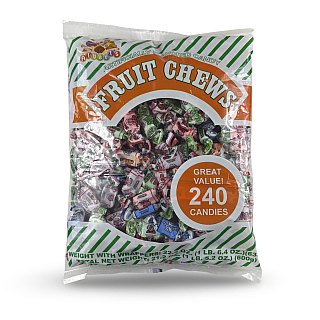
A 240-count bag is a commitment, and the two questions worth answering before
you buy one are whether the arithmetic works and whether you can keep them in
usable condition. Both have clear answers.
The arithmetic
A 240-count bag weighing one pound gives a useful anchor that holds across
most wrapped chews:
240 pieces ÷ 16 oz = 15 pieces per ounce, and each piece is therefore
about 1.9 grams.
That per-piece figure is what makes bulk formats comparable to single bars,
and it is almost always where bulk wins — not because the candy is cheaper by
weight, but because the wrapping and handling cost is spread across 240 units
instead of one.
The honest caveat: bulk is only good value if you finish it. A 240-count bag
that goes stale at 180 was more expensive than a small bag you ate entirely.
Which is really a storage question.
Why wrapped chews keep as well as they do
Three things are working in your favour:
Low water activity. These are dense sugar with very little free moisture,
which means very little for microbes to work with. Wrapped chews do not spoil
in the way a baked good does; they degrade in texture.
Individual wrapping. Each piece has its own barrier. Opening the bag does
not expose 240 pieces to the air — it exposes one bag's worth of headspace.
No fat to go rancid. Fruit chews are largely sugar, glucose syrup and
flavouring. The fat content that limits shelf life in chocolate and baked
goods is mostly absent.
The failure mode is not spoilage. It is fusing and hardening.
The two things that actually ruin them
Heat. Above roughly the mid-eighties Fahrenheit, chews soften and the
wrapper stops being a barrier — pieces press together and the wrappers bond to
the candy. A bag left in a car in July is the classic loss. Cool is more
important than dark.
Humidity fluctuation, more than humidity itself. Sugar draws moisture in
damp conditions and releases it in dry ones, and repeated cycles turn a soft
chew grainy. A stable cupboard beats a cool-but-variable garage.
Storing 240 pieces properly
Leave them wrapped. Decanting into a jar removes the individual barrier
that is doing most of the work.
Split the bag. Keep a small working supply where you will use it and the
rest sealed. Every opening exchanges the air in the main bag.
Airtight container, not the original bag, once opened. A rolled-down bag
is not a seal.
Room temperature. Not the fridge — condensation on the way in and out is
the exact humidity cycling that damages them.
- Away from anything aromatic. Wrappers are not odour-proof. Chews stored
Single flavour or assorted
A genuine decision rather than a preference:
Assorted is right when the audience is unknown — a bowl, an event, a
classroom. Everyone finds something.
Single flavour is right for a household, and it is under-used. Assortments
guarantee that the least popular flavour is the one still in the bag at the
end. If you know your house likes one thing, a whole bag of it is a better
purchase than four-sixths of an assortment.
When a 240-count is the wrong buy
If it is for one occasion and the leftovers have no home, buy less. The value
case rests entirely on the tail — on those pieces still being good in a drawer
four months later. If there is no drawer, there is no saving.
Featured Products in This Article
Taste the snacks discussed above, shipped fast directly from our NY warehouse!

