

Both are sweet breakfast pastries sold individually wrapped in the same aisle.
They are built on different doughs, and that single difference decides
everything about how they eat, keep and reheat.
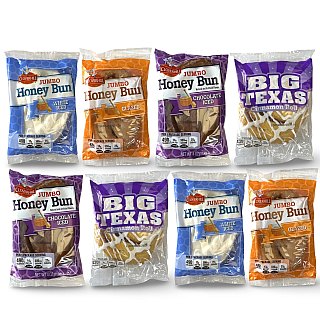
Honey bun: enriched dough, glazed
A honey bun is a soft enriched dough — flour, sugar, fat, usually yeast-risen
— rolled with cinnamon and finished with a glaze. It is closer to a doughnut
than to a pastry.
The texture is uniformly soft. There are no layers to speak of; the swirl is
visual and aromatic rather than structural. Bite through one and it compresses
rather than flakes.
That softness is why honey buns travel so well. There is no delicate structure
to crush, so a squashed honey bun is a slightly flatter honey bun rather than
a ruined one.
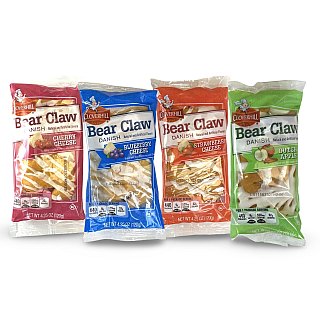
Bear claw: laminated dough, filled
A bear claw is a laminated pastry — butter folded through dough in layers —
usually with a filling and the characteristic cut "toes" along one edge that
give it the name.
Lamination means the eating experience is layered: crisp at the edges, softer
toward the middle where filling has kept things moist. It is a more variable
bite, and considerably more fragile.
The practical differences
Which survives a bag or a glovebox: honey bun, easily. Lamination is
exactly what gets destroyed by pressure.
Which reheats better: bear claw, and it is not close. Warming re-melts the
butter between the layers and genuinely restores it. A microwaved honey bun
goes from soft to gummy, because there is nothing structural to restore — just
sugar and fat getting hot.
Which is sweeter: honey bun, usually and by some distance. The glaze
covers the whole surface, and the dough itself is sweetened. A bear claw
concentrates its sweetness in the filling, so the pastry around it reads
comparatively plain.
Which goes stale faster: the bear claw. More surface area, more exposed
edges, and the crispness is the first thing to go. Honey buns stay acceptable
much longer because soft-to-slightly-softer is a smaller fall than crisp-to-limp.
What to choose, by situation
Eating it in a car or at a desk: honey bun. No flakes, no crumb, survives
being carried.
Eating it at a table with coffee, warmed: bear claw. The whole point of
lamination is wasted if you eat it cold from a wrapper.
Buying for a group, days in advance: honey bun. The shelf life and the
handling are both more forgiving.
Buying to impress: bear claw, warmed. It reads as bakery rather than
packaged.
Reheating, briefly
Bear claw: a few minutes in an oven or toaster oven. Not a microwave —
steam is the enemy of layers.
Honey bun: ten seconds in a microwave and no more, or leave it alone.
Overheated glaze goes molten and then sets hard and grainy as it cools.
- Neither wants the fridge. Refrigeration stales baked goods faster than
The honest verdict
The bear claw is the better pastry and the honey bun is the more useful
product. If you are eating it at a table, take the bear claw. If it is going
in a bag, take the honey bun and do not pretend it is a compromise — it was
designed for exactly that.
Featured Products in This Article
Taste the snacks discussed above, shipped fast directly from our NY warehouse!

