

Most things sold as "crumb cake" in America are coffee cake with a dusting
of streusel on top. New York crumb cake is a different object entirely, and
the difference is a ratio you can measure with your eyes.
The rule: more crumb than cake
On a proper New York crumb cake, the crumb layer is as thick as or thicker
than the cake beneath it. Half the slice, or more, is topping. If you can
see mostly cake with a sprinkle over it, you are eating something else — and
it is probably fine, but it is not this.
That ratio is the whole identity. Everything else follows from it.
Why the crumbs are boulders, not sand
Streusel and New York crumb are made differently, and it is not a small
distinction:
Streusel is cut cold, like pastry. Cold butter is rubbed into flour
and sugar, and it bakes into something sandy and fine.
New York crumb is made with melted butter, worked into flour, sugar
and cinnamon until it clumps. Those clumps get broken into large,
irregular pieces by hand and piled on.
Melted butter is why the crumbs hold together as chunks instead of
dispersing, and why they stay slightly damp rather than going crisp. A dry,
crunchy topping means it was made cold.
The cake underneath has a job
The base is deliberately plain and on the dense side — usually a butter cake
rather than a light sponge. That sounds like a shortcut. It isn't. A tall
pile of sweet, buttery crumb needs something firm and restrained under it or
the whole slice reads as sugar. An airy sponge would also collapse under the
weight.
So if the cake layer tastes a little unremarkable on its own, it is doing
exactly what it was designed to do.
Confectioner's sugar, and what it hides
A heavy snowfall of powdered sugar is traditional — and it is also the
easiest way to disguise a thin or uneven crumb layer. Tip a slice on its
side and look at the cross-section. The ratio does not lie.
What "Brooklyn-style" actually means
Very little, as a regulated term. Anyone can print it. In practice, when
people say Brooklyn or Tribeca crumb cake, they mean the bakery version:
thick crumb, plain base, cut in generous squares rather than thin wedges.
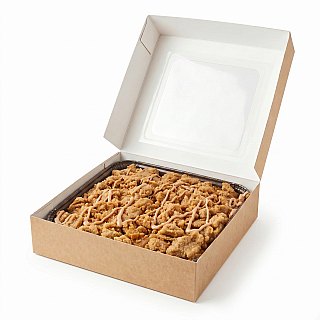
The version we stock is made to that shape:
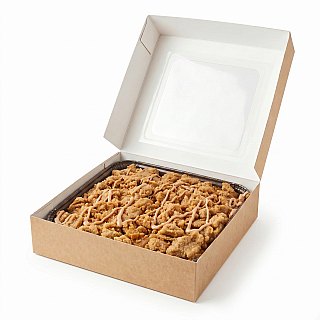
There is also an apple cinnamon version, where the fruit adds moisture to
the base and shifts the balance a little sweeter:
Storing it without ruining the crumb
This is where most people lose the texture.
Never the fridge. Refrigeration dries the cake and turns the crumb
hard and grainy. Room temperature, in an airtight container, for up to
about three days.
Do not stack slices. The weight compacts the topping into a solid
crust. Single layer, or separated with paper.
Reheating: ten seconds in a microwave softens the butter in the crumb
and brings it back close to fresh. Longer than that and the base goes
tough.
Freezing works, which surprises people. Wrap well; thaw at room
temperature still wrapped, so condensation forms on the wrapping and not
on the crumb.
The two-fork test
A good New York crumb cake sheds. Cut a slice and you should lose crumbs to
the plate — that is the sign of a topping made with melted butter and piled
on loose, rather than pressed down into a lid.
If your slice stays perfectly tidy, the crumb was compacted. Still cake.
Just not this cake.
Featured Products in This Article
Taste the snacks discussed above, shipped fast directly from our NY warehouse!

