

Bubble gum exists because of a failure, was perfected by an accountant, and is
pink for no reason at all. The history is better than the marketing.
Chewing gum came first, and it did not blow bubbles
Chicle-based chewing gum was established in the United States by the late
1800s. It chewed well and it flavoured well, but it could not hold a bubble —
the base was not elastic enough. Blow into it and it tore.
That gap is the whole story of what came next.
Blibber-Blubber: the first attempt, and why it failed
In 1906, Frank Fleer produced a gum formulated to stretch. It worked, in the
narrow sense that it made bubbles. It was also too sticky and too wet to sell:
a burst bubble left residue on the face that could not be rubbed off, and the
gum lost structure quickly in the mouth.
It never went to market. The name — Blibber-Blubber — is the most enduring
thing about it.
You will sometimes see this era referred to under other names. Blibber-Blubber
is the documented one.
1928: Walter Diemer gets it right
Diemer was an accountant at Fleer, experimenting with gum formulations
outside his actual job. His version was less sticky and more elastic — it held
a bubble and released cleanly from skin. Fleer marketed it as Dubble Bubble,
and it became the foundation of the modern bubble gum category.
Two details that have shaped the category ever since:
The pink. Diemer used the food colouring that happened to be on the shelf.
There was no branding logic and no market research. Pink became the convention
because the first successful product was pink, and everyone followed.
The bubble-blowing lesson. Fleer's salespeople were taught to demonstrate
it, because customers did not know gum could do that. The product had to teach
people what it was for.
What changed since, and what didn't
The base moved from chicle to synthetic polymers — more consistent, more
available and not dependent on a tropical harvest. Flavour systems improved
enormously; the original bubble gum flavour is not any particular fruit but a
blend, and it has been refined rather than replaced.
The fundamentals have not moved. A modern bubble gum is still a
non-digestible elastic base carrying sugar and flavour on the outside, and it
still stops tasting of anything after a few minutes for the same reason: the
sweeteners dissolve away and the base does not.
The filled gumball is the one genuine innovation
A filled centre solves the flavour-fade problem, at least partly. The shell
delivers the first hit; the filling arrives second, at the point where a plain
gum would be going flat.
It also changes the chew. You get a hard crack, then a soft release, then the
long elastic phase — three textures from one piece (we break down the varieties in our
Filled Gumball Experience Guide).
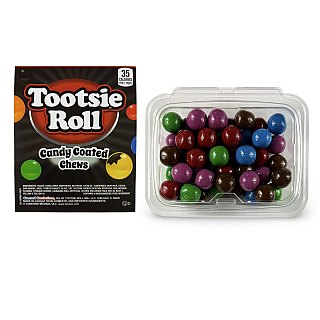
Why gumballs are round and shiny
Not aesthetics. The hard candy shell is applied by panning — tumbling the
centres in a rotating drum while syrup is added in layers. Round is what
tumbling produces, and the shell exists to keep air out. Gum hardens as its
plasticisers migrate; a sealed shell slows that considerably.
Which is also why a gumball from an old machine can still be perfectly good,
and an unwrapped stick of gum of the same age will not be.
Storing gum properly
Airtight, room temperature. Gum does not spoil. It hardens.
Never the fridge. Cold makes the base brittle, and the first chew of a
cold gumball is where teeth meet trouble.
- Keep it away from strong smells. The shell is porous enough to pick
Featured Products in This Article
Taste the snacks discussed above, shipped fast directly from our NY warehouse!


